How many business cards do you think you’ve collected over the past year? Now, how many of those can you actually find right now?
If you’re anything like most professionals in the UAE, that stack of business cards is probably sitting in a drawer somewhere, half of them bent, a few with faded text you can’t read anymore. Meanwhile, your phone, the one in your hand right now, has been with you every single day, in every meeting, every networking event, and every coffee catch-up with potential clients.
The business card game has changed. And if you haven’t noticed it yet, you will soon.
Why Physical Cards Are Fading: The Death of Paper in a Digital World
Let’s be honest. How often do you actually use someone’s business card after they hand it to you?
You get it in a meeting. You stick it in your pocket. Maybe you put it in your wallet. And then what? You get home, you’ve got a stack of cards from the networking event you attended, and you’re supposed to manually enter all that information into your phone. Most people don’t. They just toss them.
Physical business cards served a purpose. They still do, in some contexts. But the reality is that they’re becoming increasingly irrelevant, especially in a place like the UAE where everything moves fast and everyone’s already digital.
Think about it: if you’re a startup founder in Dubai pitching to investors, do you really think they’re going to remember your card? No. They’re going to remember you. Your energy. Your idea. And if they want to follow up, they’re going to search for you on LinkedIn or Google, not dig through a pile of paper.
The shift away from physical cards isn’t just about convenience. It’s about momentum. The UAE is one of the most digitally advanced regions in the Middle East. Dubai’s Vision 2030, Abu Dhabi’s digital transformation initiatives and the rapid adoption of cashless payments are a market that’s already ahead of the curve. Clinging to paper business cards in this environment just makes you look like you’re not keeping up.
Plus, let’s talk about the practical stuff. Printing cards costs money. Designing them takes time. Ordering new ones when your job title changes or your business pivots takes even more time. With a digital business card, especially one built right into your phone case with a QR code, you change things once, and it’s updated everywhere. Instantly. No reprinting. No waste. No hassle.
For businesses in the UAE, where efficiency and modernization are everything, the fade of physical cards isn’t a loss. It’s progress.
Why the Phone Is the New Identity Tool: Your Personal Brand in Your Hand
Your phone isn’t just a communication device anymore. It’s become your identity.
Think about how many hours a day your phone is in your hand or visible on a table. Think about the people who see it. In meetings, your phone sits on the desk. At networking events, you’re checking messages, reviewing notes, and taking photos. In presentations, it’s right there next to your laptop. Your phone is literally more visible to other people than almost anything else about you except maybe your face.
This is why your phone has become the ultimate identity tool. It’s not abstract. It’s real. It’s tangible. And it’s constantly communicating something about who you are.
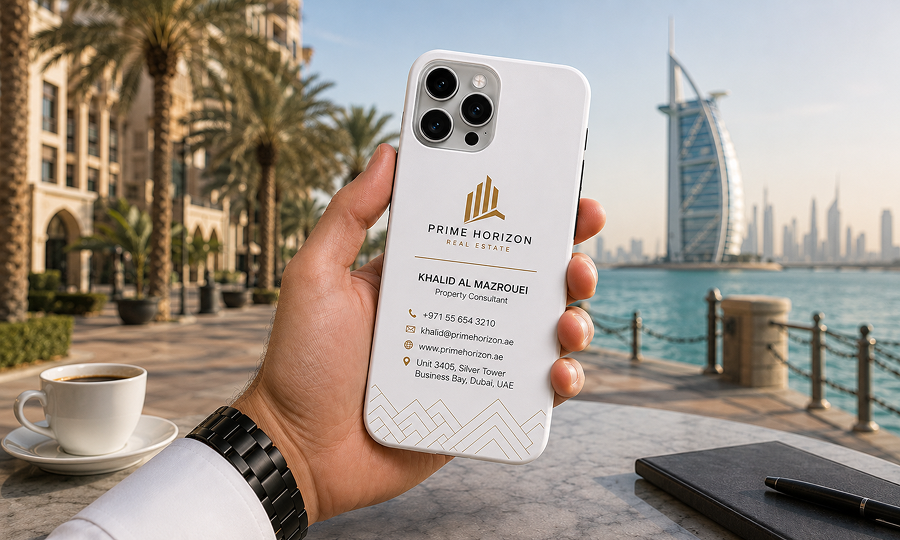
When someone sees you using a sleek, professional phone with a custom case that has your branding on it, they immediately form an impression. This person is professional. They care about their image. They’ve thought about their brand. They’re not just using whatever case came in the box. That’s the power of the phone as an identity tool.
For professionals in the UAE market, this is particularly important. You’re competing against people from around the world. You’re working in industries that value image and professionalism. Your phone and, specifically, your phone case have become one of the first things people notice about you in a business context.
And here’s the thing: your phone is always there. A business card gets handed over once and forgotten. Your phone is present throughout the entire interaction. It’s in photos you take together. It’s there when you pull up information to discuss. It’s on your desk when you’re having a video call. It’s constantly reinforcing your professional identity.
The phone as an identity tool isn’t just about vanity. It’s strategic. It’s a tool for building recognition and establishing yourself in your market. In the UAE’s competitive business landscape, that’s invaluable.
The Hybrid Advantage: Physical Presence Meets Digital Access
The rise of digital doesn’t mean physical completely disappears overnight. But it does mean that the smart approach is hybrid.
You’ve got your phone with its custom case and QR code; that’s your primary identity tool. That’s what’s always with you, always visible, always making an impression. But you might still carry a few physical cards for those situations where someone specifically asks for one or where it just feels right. The difference is those cards now serve as a reinforcement, not your primary strategy.
In the UAE, where business culture appreciates both tradition and innovation, this hybrid approach works perfectly. You’re not completely abandoning the old way of doing things. You’re just acknowledging that the new way is more effective.
Think of it this way: physical cards are like a backup. But your phone? Your phone is the main event.
For professionals navigating the UAE market, whether you’re in Dubai’s tech startup scene, Abu Dhabi’s corporate sector, or anywhere in between, the phone-as-identity tool combined with digital connection options through QR codes is just smarter business. It’s faster. It’s more professional. It’s more memorable. And most importantly, it actually works.
Making the Shift: Practical Steps for UAE Professionals
So how do you actually make this transition? It’s simpler than you might think.
First, get a quality custom phone case. This isn’t the time to go cheap. Your phone case is a business tool, not just an accessory. Invest in something that reflects the quality of your work. In the UAE, there are excellent local providers like Kiosky that can produce a professional custom case quickly, usually within 72 hours, which means you don’t have to wait around.
Second, think about your design. Keep it professional. Your logo, your name, your brand colors. Nothing too trendy or elaborate. You want it to look good in a year, not just this week. And remember: someone’s going to be seeing this from across a conference table. Make sure it’s legible and clear.
Third, add your QR code. Decide where it goes. On the back? Incorporated into your logo? Along the edge? Work with the designer to integrate it thoughtfully. Test it before you finalize the order to make sure it scans properly. Link it to your LinkedIn, your website, your portfolio, or wherever it makes sense for your business.
Fourth, start using it. Use it in meetings. Have it visible on your desk during video calls. Include it in photos when you’re at networking events. Build the habit of letting your phone case do its job as an identity tool.
And finally, let go of the physical cards as your primary strategy. Keep a stack around for those rare moments when someone asks. But don’t rely on them. Don’t put all your effort into designing, printing, and distributing something that’s going to get lost anyway.
The shift to digital doesn’t happen overnight. But it is happening. And the faster you adapt, the more competitive you’ll be in the UAE’s fast-moving business environment.
The Future Isn’t Coming—It’s Already Here
Business cards used to be essential. Now they’re optional. That’s not a prediction about the future. That’s the current reality in the UAE.
Every month that goes by, more professionals are ditching the card stack and doubling down on their digital presence. More people are expecting that frictionless connection from QR code to LinkedIn. More businesses are realizing that the phone isn’t just a communication tool; it’s a branding platform.
If you’re still operating like it’s 2015, it’s time to catch up. Your phone, your brand, and your custom case that’s your business card now. Make it count.
FAQs
Q: Are physical business cards completely dead?
A: Not completely, but they’re definitely becoming less central to how professionals connect. In the UAE, the trend is definitely moving toward digital-first strategies. Physical cards are now more of a backup or gesture rather than a primary networking tool. Most professionals expect to connect with you digitally through LinkedIn or by scanning a QR code rather than through a paper card.
Q: What phone models can I customize?
A: Most UAE providers support all the popular models: iPhone, Samsung, Xiaomi, OPPO, Huawei, Google Pixel, Realme, and others. Check with your provider, but they’ll almost certainly have your model available.
Q: Is this trend specific to the UAE, or is it everywhere?
A: The shift toward digital business cards is happening globally, but it’s particularly pronounced in the UAE. Dubai and Abu Dhabi are among the most digitally advanced regions in the Middle East, so professionals here are already ahead of the curve. If you’re working in a competitive market like the UAE, this is something you should be paying attention to now, not later.
Q: What if my business is super traditional or conservative?
A: Even traditional industries in the UAE are going digital. A custom phone case doesn’t have to be flashy; it can be minimal and elegant, with just your company name and logo. It’s still a modern, professional move.
Q: Is investing in a custom phone case worth it for networking?
A: Absolutely. Think about it: one custom case costs maybe AED 75-150. If it leads to even one meaningful business connection, one client, or one partnership per year, it’s paid for itself. Given that you interact with potentially hundreds of people in a year, the ROI is pretty solid. It’s one of the most cost-effective professional investments you can make.
Q: How do I make sure my phone case doesn’t get damaged quickly?
A: Invest in a quality provider and good materials. Cheap cases fall apart. A professional case from a reputable provider in the UAE will last 12-18 months with regular use. Since it’s a business tool, quality is worth the extra cost. You want it looking professional the entire time you’re using it.
Q. Can I order a custom Samsung phone case in the UAE?
Yes. You can personalize Samsung phone cases for a wide range of Galaxy models, including the Galaxy S Series, Galaxy A Series, and many other Samsung smartphones.